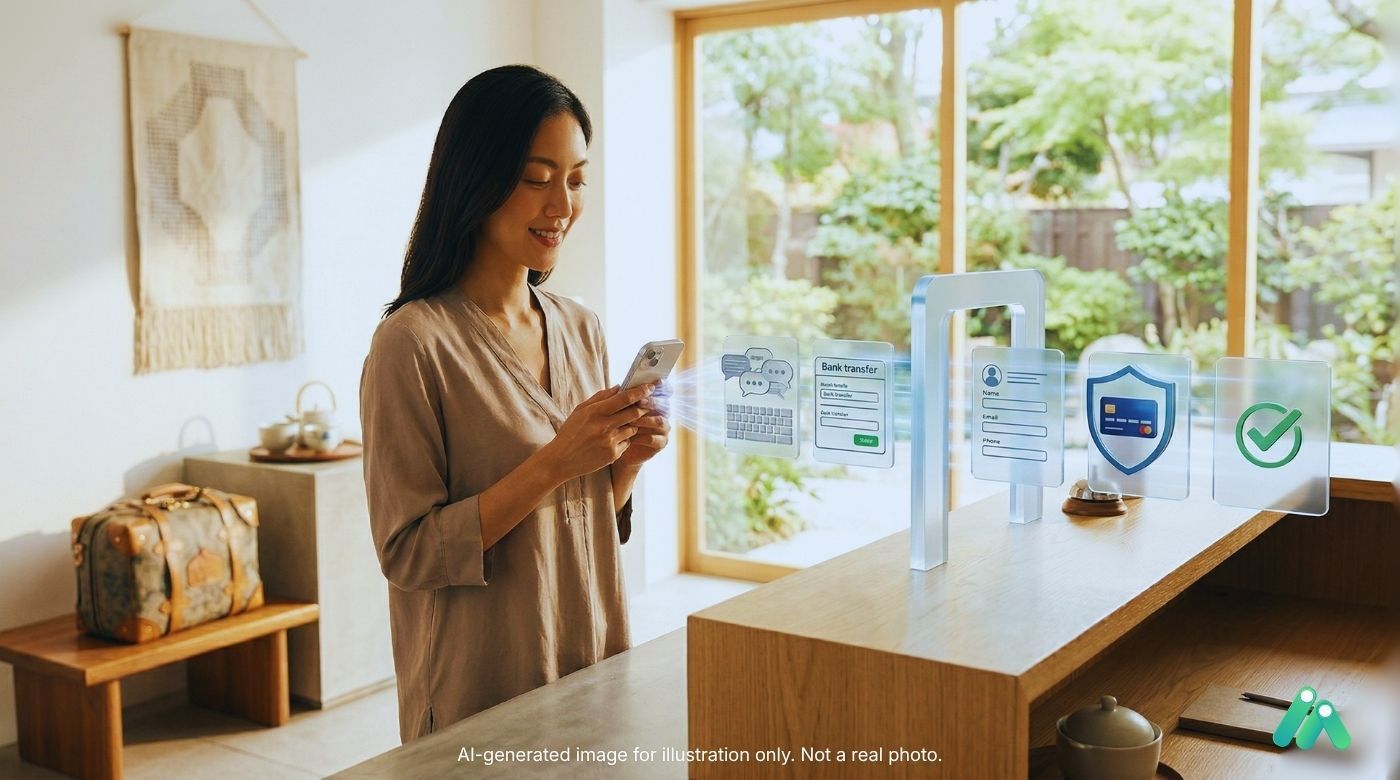
How Small Hotels can increase Direct Bookings by fixing the Messenger Booking Flow
TL;DR: Many small hotels do not lose direct bookings because people are not interested. They lose them because the booking process inside Messenger feels slow, manual, and risky right before payment. When guests wait too long, type everything by hand, and send money based on chat instructions, trust drops. A clearer and safer booking flow can help turn more direct inquiries into confirmed bookings.
Recently, we booked a room for my kid. We inquired through Facebook, waited around an hour for a reply in Messenger, typed out all our details manually, and then got sent a GCash or Maya account number for payment. We still paid because we were in a rush.
That experience stayed with me.
Not because I thought the hotel was fake, but because the whole process felt like something that could easily be faked. And that is the real issue.
If you want to increase direct bookings for small hotels, you cannot only focus on getting more inquiries. You also have to look at what happens after the inquiry comes in. A lot of small hotels and resorts are already getting interest through Facebook. The problem is that the booking flow often feels too informal right before payment.
That matters even more today. The PNP Anti-Cybercrime Group has warned the public about vacation scams during peak travel periods, and tourism leaders in Cebu have also raised concern about booking scams using copied pages and Messenger-based conversations. At the same time, this is clearly where people are. DataReportal reported 65.8 million Messenger users reached by ads in the Philippines in late 2025, and the Bangko Sentral ng Pilipinas said digital retail payments reached 57.4% of monthly retail payment volume in 2024. People are already comfortable with chat and digital payments. What makes them hesitate is when the booking process does not feel official enough to trust.
Why do guests hesitate right before paying in Messenger?
Guests hesitate when they cannot quickly confirm three things: that the property is real, that the room is really available, and that the payment is going to the real business.
This is what I think many small hotel owners miss. The guest may already want to book. They may already like the property, accept the price, and be ready to move. But then the process becomes manual.
They are asked to type out their full name, contact details, travel dates, number of guests, and other information one line at a time. Then they are told where to send payment. Then they are asked to send a screenshot. Then they wait for confirmation.
That is where confidence drops.
Local coverage of booking scam patterns in Cebu shows why this matters. Scammers also use Messenger, copied pages, and chat-first conversations. So even if your hotel is legitimate, a manual booking process can still feel risky from the guest side. That is also why we wrote our earlier post on hotel booking scams in the Philippines. The issue is not only fraud. The issue is that a real booking flow can look too much like one.
The manual booking routine that quietly kills direct bookings
From the hotel side, the routine may feel normal. From the guest side, it often feels tiring.
A guest asks if a room is available. They wait for a reply. A staff member checks manually. The guest sends their details. Payment instructions are typed into chat. The guest sends proof of payment. Then they wait again for confirmation.
Each step adds friction.
The guest has to do more work. The booking feels slower than expected. The payment feels informal. The confirmation feels uncertain. And because the whole thing happens in chat, it can feel easy to fake.
This is important because direct bookings do not only happen through a hotel website. Cloudbeds explains that direct bookings can come through a website, email, social media, and messaging tools like Messenger. So Messenger can absolutely help drive direct bookings. But only if the experience feels organized and trustworthy.
A lot of small hotels think they need more traffic. In some cases, that is true. But in many cases, they already have guest intent. They are just losing it in the last few steps before payment.
How much can a slow reply really cost a small hotel?
A slow reply costs more than time. It weakens momentum.
When a guest sends a message asking if a room is available, that is often not casual curiosity. They may be deciding right then. They may be comparing several properties at once. They may be booking for family, a work trip, or a rushed schedule.
If the reply comes too late, the booking energy drops.
Cloudbeds' guidance on hotel messaging and direct bookings points to the same thing. Faster and more immediate communication helps hotels convert more direct bookings, especially in channels where guests expect quick answers.
This is where small teams get stuck. Owners and staff are not just replying to messages. They are handling check-ins, housekeeping coordination, calls, walk-ins, and day-to-day operations. That is why a Messenger-ready BrainBot matters. Not because it sounds advanced, but because it helps keep a warm inquiry warm while your team is busy.
What makes a direct booking flow feel official and safe?
A safer booking flow gives the guest clarity at the exact moment when doubt usually appears.
The guest should be able to see room details clearly. They should know whether the room is available. The payment step should be tied to the business. After payment, they should receive confirmation quickly.
This matters because people are not avoiding digital payment itself. The BSP’s payment data already shows strong digital payment use in the Philippines. The issue is not willingness to pay online. The issue is whether the payment process feels reliable.
A direct booking flow feels more official when it includes:
- clear room details and rates
- availability shown right away
- a secure payment link tied to the business
- fast confirmation after payment
- a branded email or invoice the guest can keep
That is the gap a digital front desk for small hotels is trying to solve. On the Stayfront page, the guest can check availability, pay through a secure link that shows the property’s official registered business name, and receive automatic confirmation with a PDF invoice. That creates a much stronger trust signal than sending payment instructions manually inside chat.
And for me, that is the heart of it. The goal is not to make the booking process look more high-tech. The goal is to make it feel more real, more official, and easier to trust.
A 5-minute booking-flow audit for small hotels
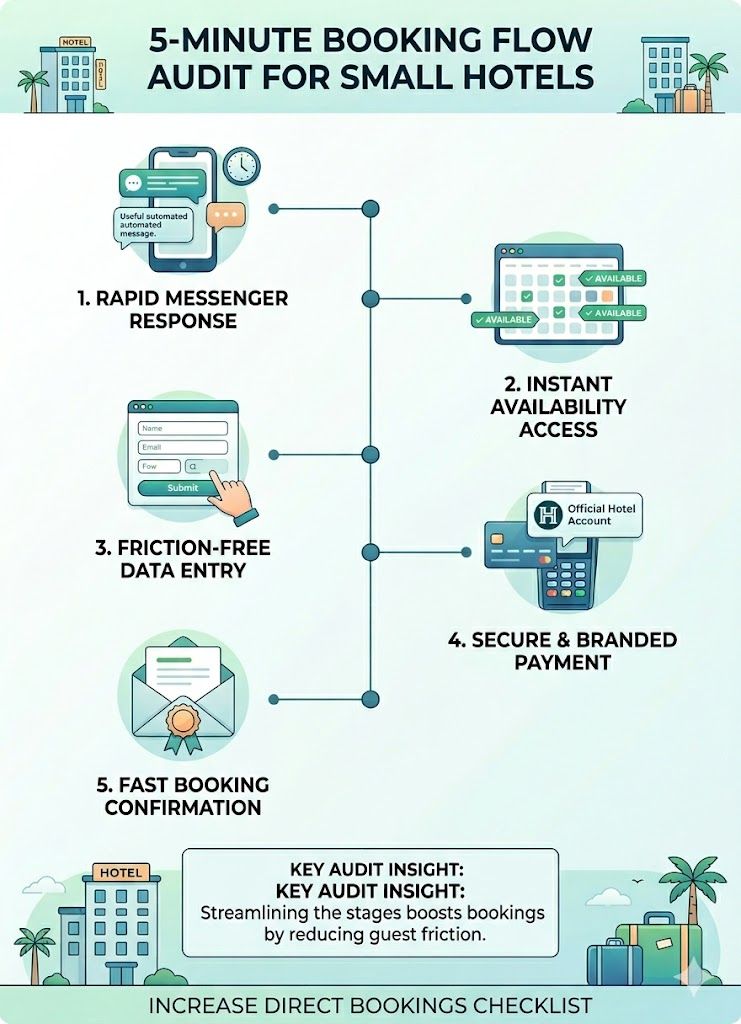
If I were talking to a small hotel owner directly, these are the five questions I would ask first.
1. How fast do you reply to new Messenger inquiries?
If someone messages at 8:15 PM, do they get a useful answer quickly, or do they wait until someone becomes available?
2. Can guests see real availability right away?
If every inquiry still needs a manual check, that creates delay and uncertainty.
3. How much information does the guest need to type manually?
The more steps they need to complete in chat, the more friction you create before payment.
4. Does the payment step clearly show your business identity?
If the booking ends with a personal payment instruction, that can lower trust very fast.
5. How quickly does the guest receive confirmation after paying?
A real booking should feel completed, not left hanging inside a message thread.
If three or more of those are weak, then the issue is not only convenience. It is likely costing you bookings. That is also why a booking-flow audit can be a helpful first step. Sometimes the clearest win is simply seeing where the trust breaks.
Can small hotels increase direct bookings without changing everything at once?
Yes.
Most small hotels do not need a full system overhaul right away. They need to fix the parts of the booking flow that make guests hesitate.
That might mean giving guests one official booking path. It might mean shortening the time between inquiry and reply. It might mean removing scattered personal payment instructions. It might mean making confirmation faster and more consistent.
Those are practical improvements. But over time, manual fixes only go so far.
If you want to increase direct bookings for small hotels in a way that is easier to manage long term, the booking flow itself has to become faster, clearer, and more trustworthy. That is why Stayfront’s 7-Day Free Trial with assisted setup matters. Small hotel owners usually do not want more complexity. They want something that helps them respond faster, reduce friction, and make direct booking feel more legitimate. That also matches the tone of our About Us page, where we focus on practical tools and real support instead of hype.
Conclusion
Many small hotels do not lose direct bookings because they lack demand. They lose them because the booking process feels slow, manual, and risky at the moment when the guest is about to pay.
That is the reality I keep coming back to.
Guests are already on Messenger. They are already used to digital payments. The real problem is when the booking flow does not feel official enough to trust. When that happens, bookings stall. When the process feels safer and clearer, more inquiries can turn into actual revenue.
If your team is still handling direct bookings through delayed chat replies, manual guest details, and personal payment instructions, this is worth fixing now. You can start your 7-Day Free Trial + Get Assisted Setup with BrainBot Stayfront, or reach out for a booking-flow audit if you want to see where your current process may be losing bookings.
Frequently Asked Questions
Why do guests stop before paying for a direct hotel booking?
Guests often stop when they cannot clearly verify the property, the payment destination, or what happens after payment. If the booking process feels too manual or unclear, hesitation rises right before the booking should be completed.
Is Facebook Messenger still a good channel for hotel direct bookings?
Yes. Messenger can still work well for direct bookings, especially in the Philippines. The issue is not the channel. The issue is whether the booking process inside that channel feels structured and trustworthy.
What makes a hotel payment link feel safer than a manual transfer?
A safer payment step makes the business identity clearer, reduces manual work, and gives the guest a more official way to pay and receive confirmation. That lowers doubt and helps the booking feel legitimate.
How can small hotels improve direct bookings without relying more on OTAs?
Start by fixing slow replies, unclear availability, manual payment instructions, and delayed confirmation. Many direct-booking losses happen inside the current process, not only at the marketing stage.
What should a guest receive right after paying for a direct booking?
A guest should receive clear confirmation with the property name, booking details, amount paid, dates, and a reference they can keep. That closes the trust loop quickly.