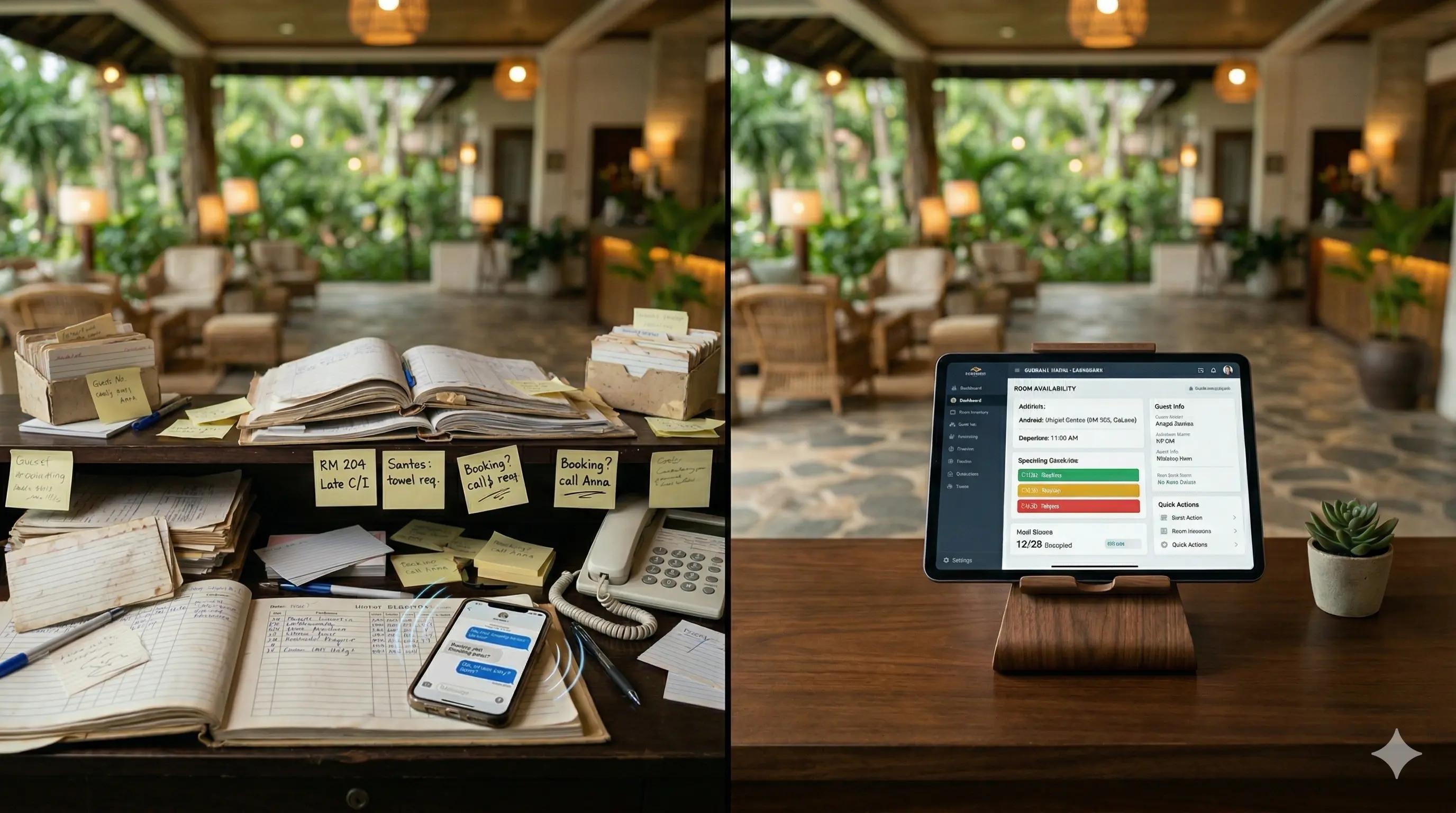
We Didn’t Build Stayfront Because AI is Trending. We Built It to Fix Messy Hotel Bookings.
The AI revolution is here, but for over a decade working in Philippine tourism and IT, we saw a frustrating reality: small hotels and resorts were getting left behind, struggling with complex tools and generic advice.
My name is Alfred Salvacion, and together with my wife and co-founder, Mariel, we run Iuvare AI. "Iuvare" means "to help, to aid, to assist". We didn't build our flagship product, Stayfront, just to jump on an AI trend. We built it because we spent years in the trenches of the hospitality industry, experiencing firsthand the daily chaos of reservations, heavy software, and scattered guest chats.
Here is the honest story behind why Stayfront exists, and the lessons we learned along the way.
The Foundation: Southwest Tours Boracay and the "Good Problem"
My career started as a junior PHP programmer and backend web developer. But my real understanding of tourism operations began when I developed the first website for Southwest Travel & Tours.
That first website proved that a digital channel could actually work. It took off, adding a completely new pillar of revenue and becoming a source of partnership for other regions interested in Boracay.

Mariel was the one handling the online bookings for Southwest. She saw the website’s demand grow so much that her online booking team expanded from just one person to 10 agents handling online reservations alone.
The turning point came when the president of Southwest Tours called a meeting. It was his initiative—he saw the growth and strongly believed that investing in IT was the only direction forward. He told me we had a "good problem"—the bookings were pouring in, but the backend was running entirely on manual index cards.
To fix this, I customized an open-source CRM (Vtiger) into a comprehensive reservation system. Developing and implementing this internal system was not easy. It took many iterations, gathering constant feedback from different department heads and stakeholders to get it right.
But once deployed, it connected everything. Because Southwest provided transportation in and out of Boracay, many of our partners were local hotels and resorts. The new system allowed the billing department to easily track and collect payments based on different arrangements, from weekly to monthly terms.

Suddenly, a single booking automatically flowed into accounting for counter-checking, connected with the billing department for those hotel partners, and generated the daily arrival and departure manifests. Operations ran smoothly, and no guest was ever left behind. We learned exactly how a connected system should work.
The Front Desk Reality: Our Time at BPHT
We eventually took everything we learned and applied it to running BPHT Booking Services. While we were part of a partnership that made the agency possible, Mariel and I were the ones managing the complete day-to-day operations.

Mariel was the Online Booking & Reservation Manager. She was the one in the trenches, processing the daily reality of reservations, modifications, and cancellations. To support her, I built the website with a backend CRM so she could multitask and manage all the bookings efficiently.
This is where our best learning happened. Because we were the core operating team, we had a very tight feedback loop. Whenever Mariel saw a gap in the system or experienced friction while handling a guest, she would tell me, and I would update the code immediately.

We saw how beautifully a system can work when it is built exactly for the person using it. The agency was doing really well—until the pandemic hit, and like many others in the tourism industry, the business unfortunately had to shut down.
The "Heavy Software" Trap: The Boracay Hotel Years
During and after that time, I also worked as an SEO Analyst and Web Developer for boutique resorts in Boracay, including 7 Stones, Pinnacle Resort & Villas, Kaaya Resort, and Aloha Boracay Hotel. I watched management at these properties fall into a recurring trap. They wanted a better system, so they would invest in heavy, third-party booking engines like Cloudbeds or SiteMinder.
Usually, these came with a channel manager. In theory, a channel manager is brilliant—it handles rates in OTAs by acting as a centralized, real-time hub that instantly syncs pricing across all connected platforms. It enables automatic, two-way updates—pushing rate changes to OTAs while pulling reservation data back, ensuring consistency, preventing overbookings, and maintaining rate parity.
But while the channel manager handled the numbers, the rest of the system was built for massive enterprise operations, not for a busy local front desk. The staff was forced to learn software that was so dense, unless you used it every single day, you would completely forget how to navigate it.
I remember logging back into one of these systems months later to help a colleague. Even as a developer, I found myself clicking through endless menus, frustrated, asking myself: Wait, where did I see this setup before?
Furthermore, the automation wasn't perfect. Because OTA integrations don't seamlessly sync all content, hotels literally had to hire extra staff just to log into different OTA extranets to manually manage their room contents, policies, and rates. They bought a system to save time, but ended up hiring more people just to run it.
And the guest experience was just as confusing. If a hotel ran a special promotion, the booking flow was often so clunky that guests couldn't figure out how to apply it. They would look at the booking engine direct booking, get confused, and end up messaging the hotel's Facebook page anyway just to ask: "How do I book this promo? How does it work?"
The expensive software didn't stop the manual messages. It just created different kinds of questions.
The Birth of Stayfront
Small hotels were stuck between a bloated, confusing enterprise PMS they couldn't easily use, or running their business on scattered, risky Messenger chats where manual payment instructions make guests feel nervous about scams.
Because of our combined experience—Mariel’s years handling the daily grind of reservations, and my years building and iterating complex CRMs—we knew exactly how to fix this. That is why we developed Stayfront.
Stayfront is the perfect middle ground. It gives your guests a beautiful, clear booking flow where promotions are easy to understand. And for your staff, we eliminated the 50-page software manuals. With our Tenant AI Assistant (TAS), there are no hidden menus to memorize. If you want to launch a promo, you don't need to hunt through settings. You just type: "Create a 15% early bird promo for the Azure Studio". The system prepares the update instantly, and nothing goes live until you explicitly review it and type Confirm.
You get the operational rigor of the CRMs we built for Southwest Tours and BPHT, with the simplicity of a chat.
Solutions for Your Reality We are strictly focused on small hotels and Philippine hospitality realities. We know what it is like to run a booking operation, we know the pain of messy software and endless iterations, and we know that your staff's sanity matters.
If your booking process still depends on scattered manual chats, or if you are fighting with a heavy system that forces you to hire extra staff just to manage it, let’s look at your booking flow together.
The first step isn't a software pitch. It's a real, no-pressure conversation. Let's walk through how your property currently handles inquiries, and see if a clearer, simpler digital front desk is the right fit for you.
Book a Free Booking Flow Review